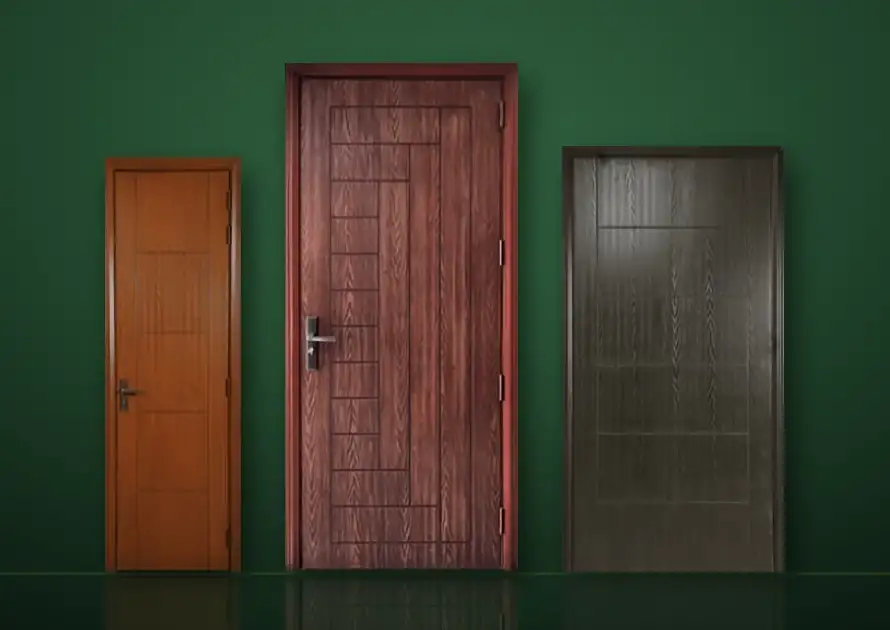
If you have ever watched a wooden door swell shut during Lahore’s monsoon, or found a bathroom door quietly eaten away by termites, you already know the problem with natural wood in Pakistan’s climate. This is exactly why more homeowners, architects, and builders are switching to WPC. But to trust a product with the entrances of your home or office, it helps to understand what goes into it. So let’s break down how WPC doors are made, step by step, and why that manufacturing process is the real reason they last far longer than traditional wood.
What Is a WPC Door?
WPC stands for Wood Plastic Composite. It is an engineered material that blends real wood fibre (usually fine wood powder) with a thermoplastic such as PVC, along with a set of performance additives. The result looks and feels like wood but behaves like a modern composite: lighter in weight, stronger, and completely resistant to water and termites.
In simple terms, a WPC door gives you the warmth and appearance of timber without the two things that destroy timber over time — moisture and pests. Green Doors was the first company to introduce this eco-friendly material to Pakistan, offering a genuine alternative to solid wood, MDF, and plywood doors.
How WPC Doors Are Made: The Step-by-Step Process
Understanding how WPC doors are made is the best way to see why they perform so differently from ordinary wooden doors. The entire process is machine-controlled, which removes the natural weak points — knots, cracks, and uneven grain — that you get with sawn timber.
1. Selecting and Preparing the Raw Materials
Quality begins with the raw material. Fine wood powder is graded, sieved, and thoroughly dried so there is no trapped moisture. This wood fibre is combined with high-grade PVC resin. Because no glue or formaldehyde is used in the core, WPC does not release the harmful fumes associated with many engineered wood boards.
2. Mixing and Compounding
The dried wood powder, plastic resin, and a carefully measured set of additives are fed into high-speed industrial mixers. These additives do specific jobs:
- Coupling agents bond the wood and plastic together at a molecular level.
- Stabilisers protect the material from heat and UV damage.
- Foaming agents control density so the door is strong yet lightweight.
- Lubricants and colorants ensure a smooth, uniform finish.
The blend is heated and compounded until it becomes one homogeneous material — this even mixing is what gives WPC its consistent strength throughout the panel.
3. Cooling and Granulation
Once compounded, the hot mixture is cooled and turned into small, uniform granules (pellets). Granulation ensures the material feeds evenly into the next machine, which is essential for a defect-free door.
4. Extrusion (or Moulding)
This is the heart of the process. The pellets enter an extruder — most premium manufacturers use twin-screw extruders because they mix more thoroughly and deliver more consistent quality. Inside, the material is melted under controlled heat and pressure, then forced through a precision die that shapes it into the door profile. For detailed designs, compression or injection moulding can reproduce intricate panel patterns and mouldings with micron-level accuracy.
5. Calibration, Cooling, and Cutting
The freshly formed profile passes through calibration and cooling systems (a water bath or air cooling). This locks in the exact dimensions and gives a smooth, flat surface. Automatic cutting machines then trim the panels to standard and custom door sizes.
6. Reinforcement (Where Needed)
For heavy-duty applications — main doors, high-traffic commercial spaces, or larger sizes — reinforcement such as internal framing can be added for extra rigidity and load-bearing strength.
7. Surface Finishing
Now the door gets its final look. Depending on the design, the surface is:
- Sanded to remove any rough edges,
- Embossed with a natural wood-grain texture,
- Laminated, painted, or heat-transfer printed for colour and an added protective layer, and
- Edge-banded to seal and neaten the edges.
This is how CNC design doors, moulding doors, and finishes are achieved without a single natural knot or flaw.
8. Quality Control
Before a door leaves the factory, it goes through checks that natural wood could never pass consistently: moisture-resistance testing, impact and durability tests, and dimensional-accuracy inspection. Because every door is machine-made, quality stays consistent from one batch to the next.
Why WPC Doors Last Longer Than Wooden Doors
Now that you know how WPC doors are made, the durability makes complete sense. The very structure of the material is engineered to survive the conditions that ruin timber.
100% Waterproof — No Swelling, Warping, or Rotting
Natural wood is porous. It absorbs water, swells in humidity, and shrinks in dry heat — the same cycle that jams doors in monsoon and leaves gaps in summer. WPC’s dense, sealed composite does not absorb water, so it stays dimensionally stable in bathrooms, kitchens, and other wet areas where wooden doors fail within a few years.
Completely Termite and Pest Proof
Termites feed on the cellulose in natural wood. In a WPC door, the wood fibre is locked inside a plastic matrix, so there is no accessible food source. This alone eliminates one of the most expensive and recurring problems for homeowners in Pakistan.
Resistant to Heat, Cold, and Salinity
Quality WPC withstands heat up to around 80°C, along with cold and water salinity. That makes it well suited to Pakistan’s extremes — scorching summers, humid monsoons, and the salty coastal air of cities like Karachi.
Low Maintenance and a Longer Lifespan
Wooden doors need regular painting, sealing, and repairs to stay presentable. WPC doors need little more than an occasional wipe. Industry estimates put the lifespan of quality WPC doors at roughly 25 years or more, while wooden doors commonly last 15–20 years in dry areas — and far less in damp rooms. Fewer replacements means WPC is more cost-effective over the life of the building.
Consistent Strength and Safety
Because they are machine-made, WPC doors have no hidden weak spots. They do not splinter or crack over time, which makes them safer in homes with children or elderly family members, and they hold up better under daily wear and tear.
WPC Doors and the Pakistani Climate
Everything above matters more in Pakistan than almost anywhere else. Our combination of monsoon humidity, intense summer heat, coastal salinity, and a widespread termite problem is brutal on natural timber. On top of that, good-quality wood keeps getting more expensive as deforestation reduces supply — and deforestation itself is a major driver of climate change. Choosing WPC reduces the demand for cut timber, so every WPC door is a small, practical step toward a greener future while also solving a very real everyday problem.
Frequently Asked Questions
Is the WPC manufacturing process eco-friendly?
Yes. The core uses no glue or formaldehyde, produces minimal waste, and reduces demand for natural timber — which helps fight deforestation.
Are WPC doors really stronger than wood?
Quality WPC is lighter than natural wood yet stronger, and unlike wood it resists water, termites, heat, and salinity, so it keeps its strength far longer.
Can WPC doors be customised?
Absolutely. Because they are moulded and finished by machine, WPC doors can be made in custom sizes, designs, and finishes — from CNC patterns to French and main-door styles.
How long do WPC doors last?
With basic care, quality WPC doors can last around 25 years or more, comfortably outlasting traditional wooden doors, especially in wet areas.
The Bottom Line
Once you understand how WPC doors are made – engineered from wood fibre and plastic, machine-mixed, extruded, and quality-tested — it becomes clear why they outlast ordinary wood. There are no gaps for water to seep into, no cellulose for termites to eat, and no natural flaws to fail over time. For Pakistan’s demanding climate, that is exactly the kind of door that pays for itself.
Ready to upgrade to doors built to last? Contact Green Doors for a free consultation and quote, or explore our full range of WPC doors.